Guardians of Holy Ground
The Franciscan Custody of the Holy Land — eight centuries of presence, preservation, and peace
Prologue: Why the Holy Land Needs Guardians
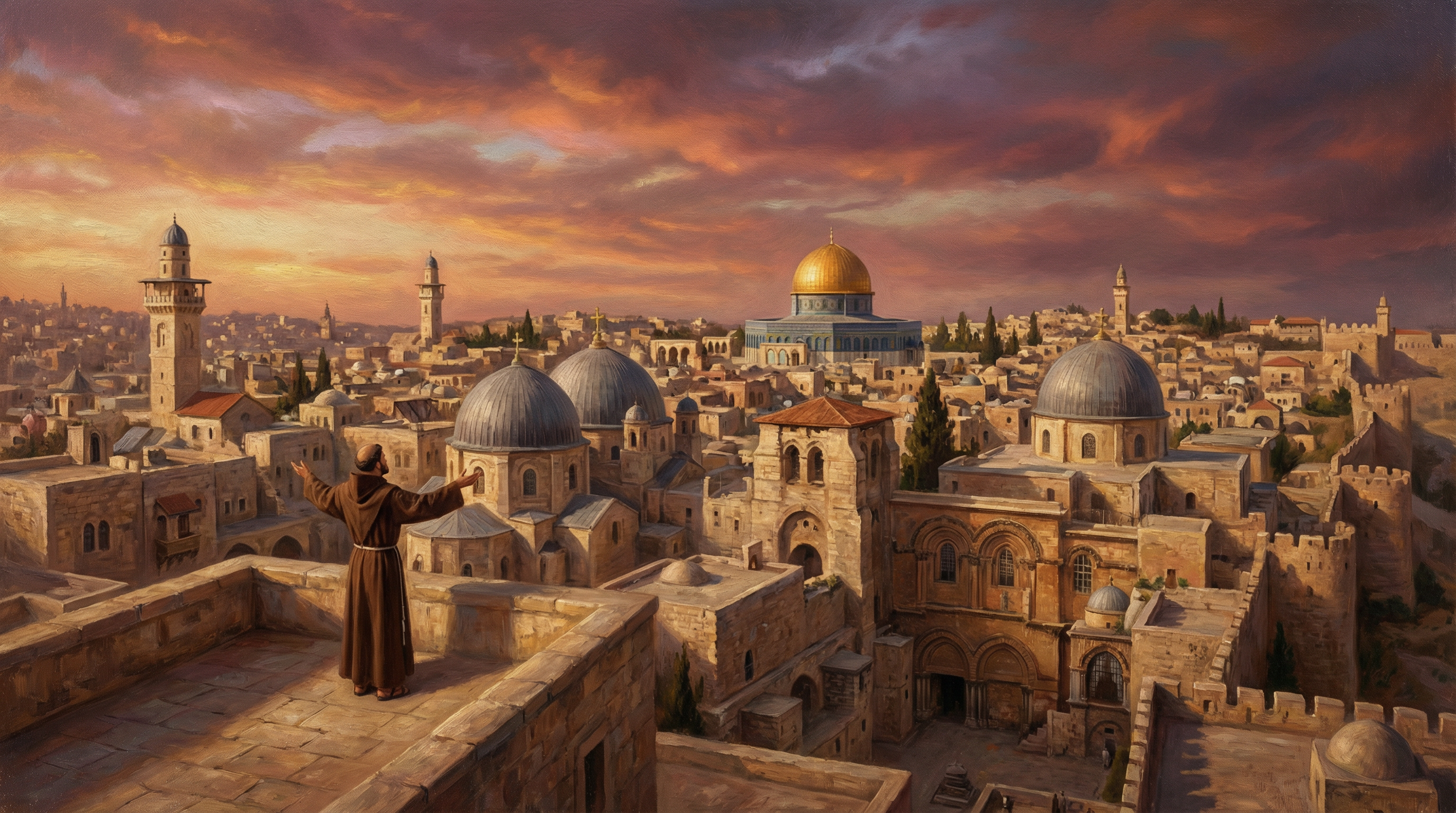
Jerusalem at dawn — city of three faiths, shrinking Christian presence, and 800 years of Franciscan vigil.
Jerusalem does not keep itself. The city that stands at the center of three world religions — the site of Golgotha, the Tomb of Christ, the Cave of the Nativity in Bethlehem, the hill where Gabriel greeted Mary in Nazareth — is also a city of contested sovereignty, shifting empires, and a steadily shrinking indigenous Christian population. In 1922, Christians made up roughly 11% of Palestine's population. By 2017, that figure had fallen to 1%. Without active intervention, the "living stones" — the local Christians who have worshipped here since the first century — will cease to exist as a community within two generations.
Into this ancient and fragile landscape steps one of the most remarkable institutions in Christian history: the Franciscan Custody of the Holy Land. Since 1217, through Crusades and Mamluk sultans, Ottoman decrees and modern wars, a community of brown-robed friars wearing rope belts has maintained unbroken presence in the land where Christianity began. They have been expelled, imprisoned, martyred, and outlasted empires. They have rebuilt churches, preserved archives, educated hundreds of thousands of children, and housed families who had nowhere else to go. They are the Catholic Church's official custodians of sacred Christendom — not because they took the land by force, but because they stayed when no one else would.
Chapter I: Francis Crosses No Man's Land
Origins · 1217–1342
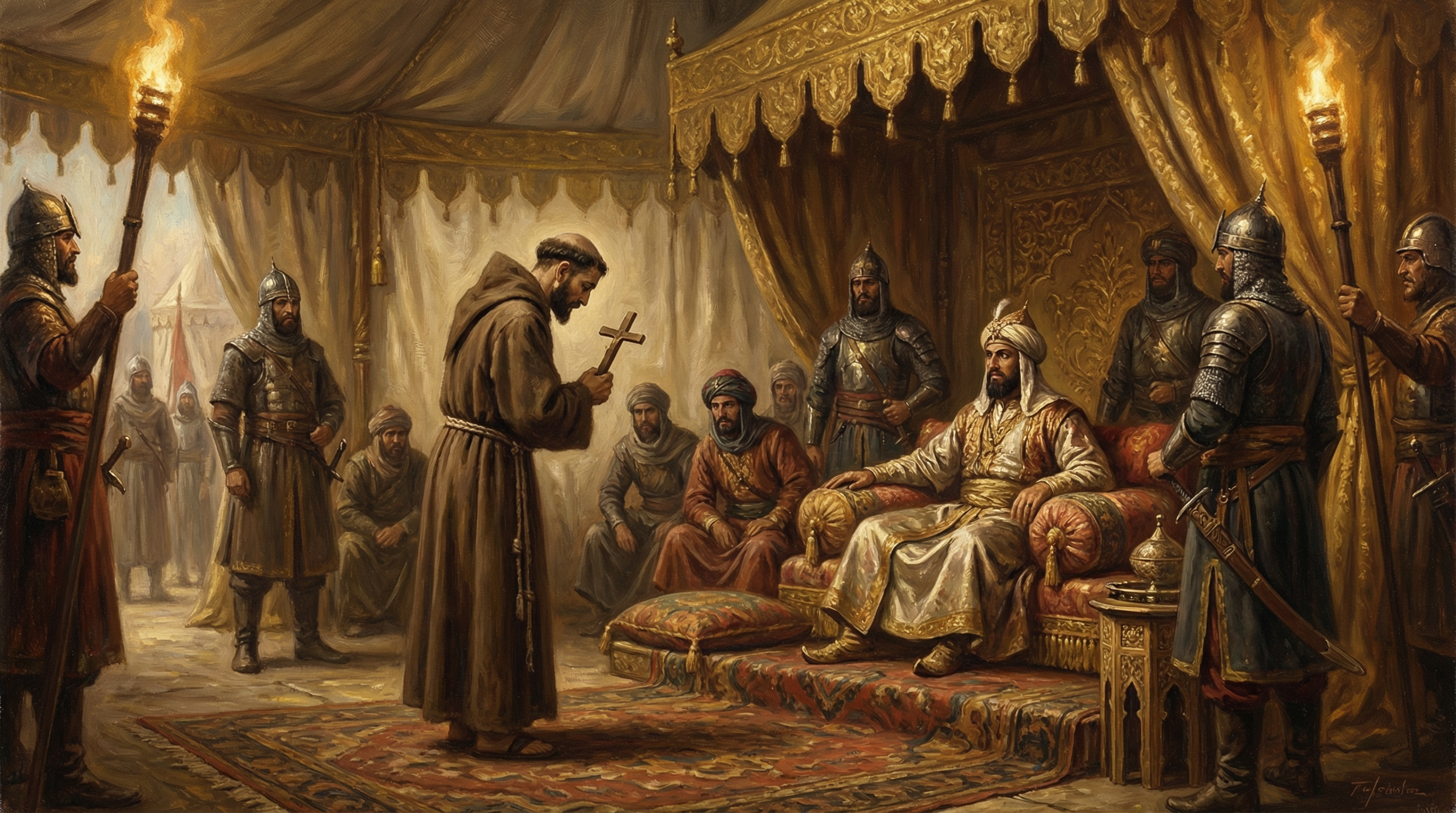
Francis of Assisi crosses Crusade lines to meet Sultan Malik al-Kamil, Damietta, 1219 — the encounter that defined the Franciscan way in the East.
The story begins not with a document or a decree but with a man walking unarmed toward armed men. In 1219, while the Fifth Crusade raged around Damietta in Egypt, Francis of Assisi crossed the battle lines. He crossed into the camp of Sultan Malik al-Kamil — nephew of Saladin, commander of the Muslim forces — carrying nothing but a wooden cross and the conviction that the Gospel was meant to be preached, not imposed.
The encounter lasted nearly three weeks. Francis preached. The Sultan listened. He sent Francis back safely to the Christian camp, reportedly moved — though unconverted. The bishop of Acre, Jacques de Vitry, who witnessed the arrival of the friar, wrote: "We saw the arrival of the friar Francis... he was immediately respected by all." The meeting became a founding image for the Franciscan way in the East: dialogue over conquest, presence over power, humility over force.
"Not without a providential plan have the historical events of the thirteenth century been brought to the Order of the Friars Minor in the Holy Land." — Pope Paul VI, Nobis in Animo, 1974
Two years before Francis met the Sultan, the first General Chapter of the Friars Minor at Santa Maria degli Angeli in Assisi had already made a bold decision. In 1217, they designated the Holy Land as one of the eleven Mother Provinces of the new order — a territory they called Ultramarina, "beyond the sea." Brother Elias of Cortona was sent to lead it. The friars who came were not diplomats or warriors; they were called "friars of the cord" by the Muslims, for the distinctive rope belt they wore.
Their presence was fragile from the start. In 1244, Franciscan blood was shed in Jerusalem during the Khwarezmian siege. In 1266, friars died at Safed with 2,000 Christians under Sultan Baibars. In 1291, when the Latin Kingdom fell at Acre, the Franciscans were expelled — a story told in full in the pages that follow. The path back to Jerusalem would take forty-two years of patience, diplomacy, and unwavering faith.
Interlude: Exile on the Island of Cyprus (1291–1333)
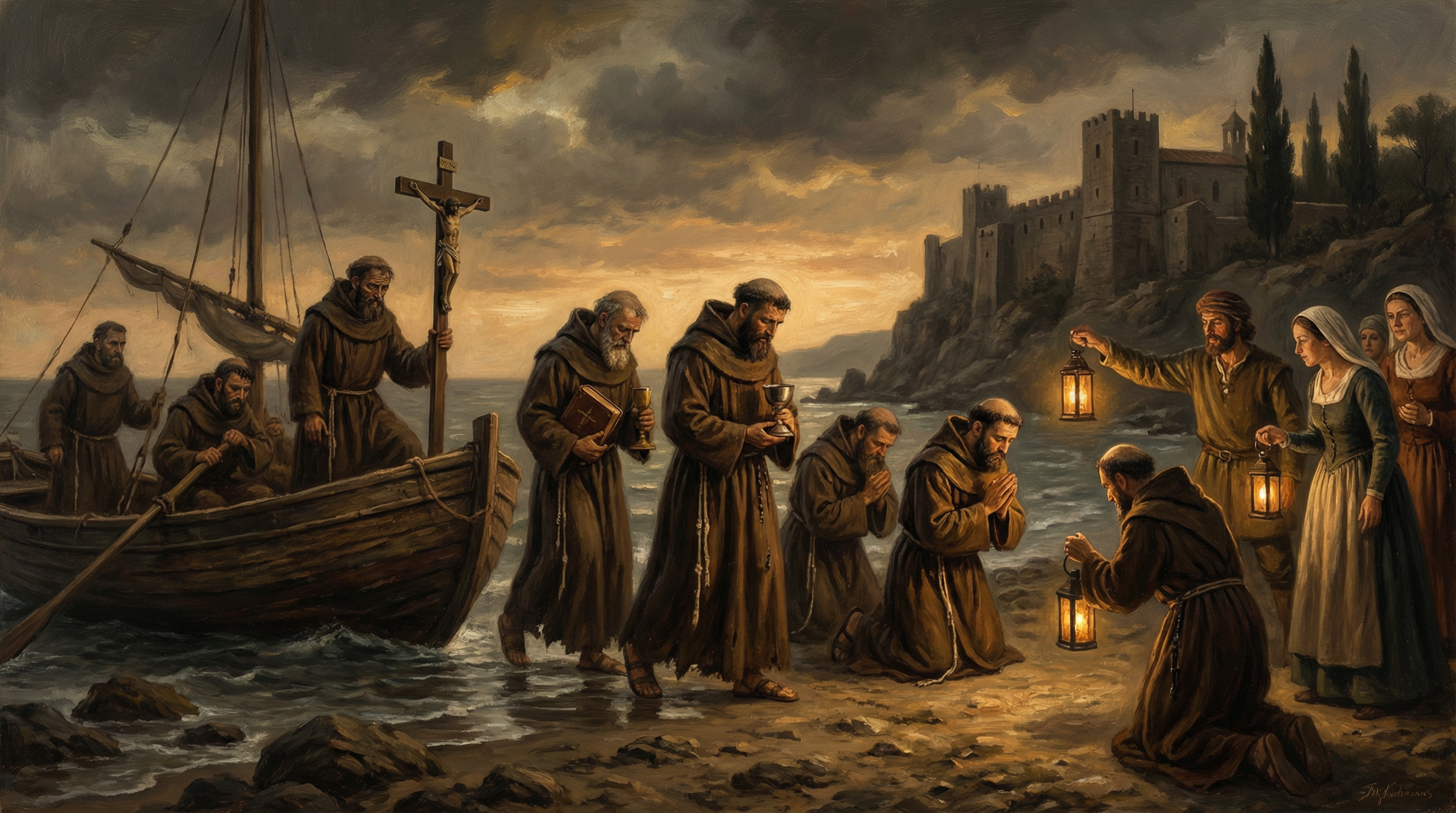
Arriving at Cyprus, 1291 — local Christians meet the exhausted friars at the shore with lanterns. The cross and chalice they carried from Acre would outlast every empire.
On May 18, 1291, the walls of Acre cracked open. The Mamluk Sultan Al-Ashraf Khalil — son of the great Qalaun — poured his armies through the breaches to the sound of 300 war drums mounted on camels. The last major Crusader stronghold in the Holy Land fell before noon. The sea behind the city filled with desperate ships: knights, merchants, clergy, and civilians rowing for their lives toward Cyprus. The Latin Kingdom of Jerusalem, which had endured for nearly two centuries, was finished.
Among the refugees were the Franciscan friars. They had maintained convents in Acre, Jerusalem, Bethlehem, Antioch, Sidon, Tripoli, Jaffa, and beyond — twelve houses in total across the Province of the Holy Land. In the space of a single morning, all of it was gone. They sailed west with what they could carry: a cross, a breviary, a chalice, the memory of holy places they feared they might never see again.
"Like exiles far from their country, their constant desire was to find the means to live near the holy places. Nothing was overlooked in the pursuit of this goal." — Custodia di Terra Santa
Cyprus was not a foreign shore. The island had long been part of the Franciscan Province of the Holy Land — the 1263 General Chapter under St. Bonaventure had formally set its boundaries to include Cyprus, Syria, Lebanon, and Palestine. The Provincial headquarters had been based there for years. But now Cyprus was not a forward post — it was the whole province. The friars settled in Nicosia, Limassol, Famagusta, and Paphos, welcomed by the Latin Kingdom of Cyprus under the Lusignan dynasty, who shared their Catholic faith and their grief over the loss of Jerusalem.
The Cypriot church received them as brothers. The friars were given shelter in existing convents, integrated into parish life, and permitted to maintain their order's structure under the Provincial Minister now residing on the island. The welcome was warm — but the longing never faded. Historical documents from the period describe friars making private devotional visits back to the holy places under Mamluk rule at considerable personal risk. They went anyway. Because someone had to witness. Because Francis had told them to go.
The Long Way Back
The return was not a single event — it was a forty-two-year negotiation conducted across courts, sultanates, and papal offices from Cyprus. Pope Nicholas IV — himself a Franciscan, the first of the order to sit on the papal throne — had already secured a Mamluk agreement before the fall of Acre allowing Latin clergy to serve at the Church of the Holy Sepulchre. The friars used this foothold, living in a pilgrim hostel in Jerusalem with no formal quarters, keeping the liturgy alive by sheer presence.
In 1309, the Sultan Baibars II issued a decree authorizing the Franciscans to settle on Mount Zion, in the Holy Sepulchre, and in Bethlehem. Then politics shifted and the decree went unfulfilled. In 1328, Pope John XXII issued the bull Cum zelo devotionis from Cyprus, formally granting the Provincial Minister the right to send two friars per year to the holy places — a small concession, but a recognized one. The friars filed back in twos, officially, legally, carrying their breviary.
The decisive turn came through the diplomacy of two monarchs and one friar. King Robert of Anjou and his wife Queen Sancha of Majorca — devout rulers of Naples and admirers of the Franciscan order — opened a prolonged and costly negotiation with the Mamluk Sultan of Egypt. Their agent was a Franciscan from the Province of Aquitaine: Friar Roger Guérin, later known as Geraldo Oddone (Eudes), acting with the full mandate of the Minister General of the Order.
Guérin succeeded. In 1333 — forty-two years after the fall of Acre — the Franciscans received legal possession of the Cenacle on Mount Zion and the right to officiate at the liturgies of the Church of the Holy Sepulchre. A convent was built beside the Upper Room. The friars had come home. From Cyprus, the Provincial structure that had sustained the exile now became the launching point for permanent re-establishment. When Pope Clement VI ratified the arrangement with his bulls in 1342, he was not creating something new. He was consecrating a return that patience, prayer, and a rope-belted friar from Aquitaine had already made real.
The Bulls of 1342: Pope Clement VI Names the Guardians
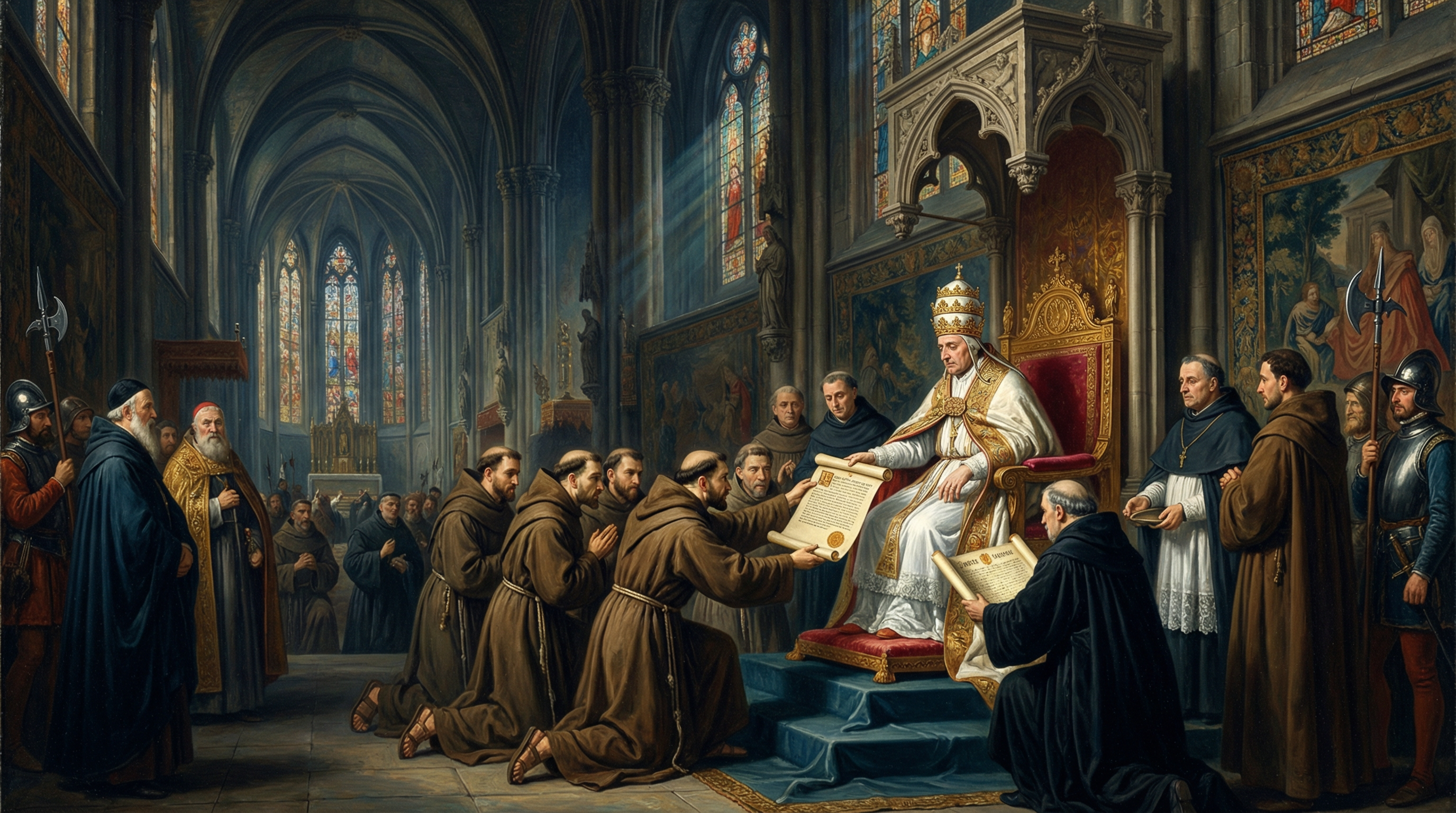
Avignon, November 21, 1342 — Pope Clement VI ratifies the Franciscan Custody with two bulls, creating an institution that would outlast every political order in the Middle East.
The decisive moment came on November 21, 1342, in Avignon. Through the intervention of King Robert and Queen Sancha of Naples — who had spent years negotiating with the Sultan of Egypt — the Franciscans had secured legal possession of the Cenacle on Mount Zion and the right to officiate in the Church of the Holy Sepulchre. Pope Clement VI ratified these agreements with two papal bulls: Gratias Agimus and Nuper Carissimae.
"The Roman Pontiff, having weighed all things carefully, grants the Friars Minor to care for and guard the holy places in the Holy Land in the name of the Catholic Church, with full authority to summon brothers from any province of the Order." — Pope Clement VI, Gratias Agimus, November 21, 1342
With those words, an institution was born. The Custody of the Holy Land became the official Catholic presence in the region — and the Custos of the Holy Land became the de facto papal delegate for the entire Christian Middle East. The friars were now, formally, what they had always tried to be: the Church's shepherds in the land of Christ.
The first headquarters was the Cenacle — the Upper Room on Mount Zion, the same room where, by tradition, Jesus held the Last Supper and where the Holy Spirit descended at Pentecost. The friars' first act was to repair it. Their second was to celebrate Mass.
Chapter II: Outlasting Every Empire — Mamluks, Ottomans
Mamluks, Ottomans, and Mandate · 1342–1948
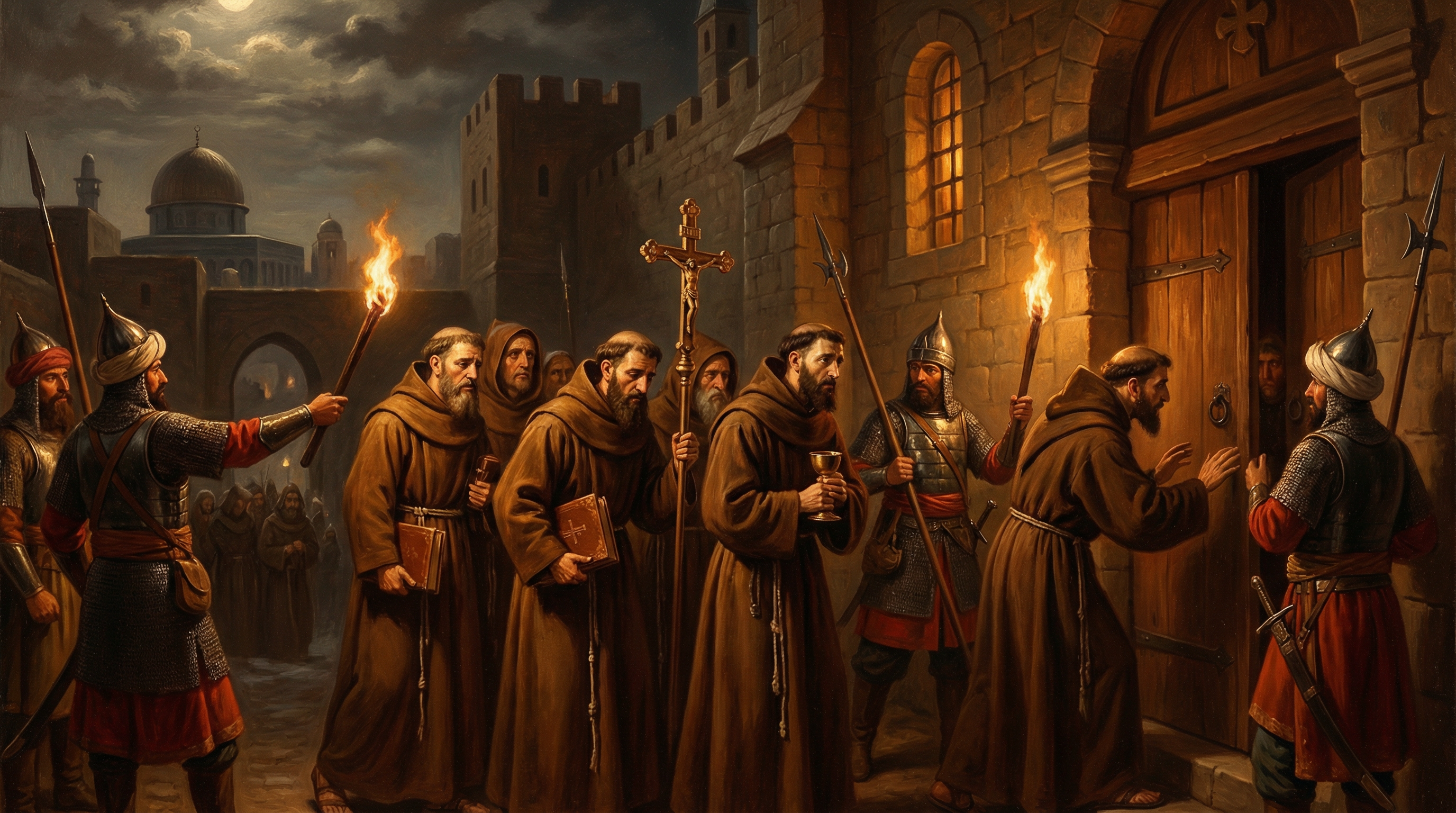
Expulsion from Mount Zion, 1551 — the friars carry their sacred objects into a new exile, while the Dome of the Rock rises in the background. They would rebuild at St. Saviour's Convent.
Under the Mamluks, the Franciscans gained significant ground: by 1347 they had established a permanent presence in Bethlehem at the Basilica of the Nativity, and by 1363 had secured rights to the Tomb of the Virgin. Yet the Mamluks were unpredictable — in 1530, friars were imprisoned for twenty-seven months. In 1537–1540, the entire communities of Mount Zion and Bethlehem were locked in Damascus for thirty-eight months.
The Ottoman conquest of 1517 changed everything. The new rulers favored the Greek Orthodox — whose lands in Greece were part of the Ottoman Empire — and subjected the Franciscans to waves of harassment, extortion, and expulsion. The most devastating blow came in 1551: the Turks drove the friars from the Cenacle on Mount Zion and its adjoining convent, the heartbeat of Franciscan activity for two centuries.
"It was a hard blow: the convent of Mount Zion had been, for two centuries, the heartbeat of Franciscan activity in the Holy Land." — Custodia di Terra Santa
They were not broken. In 1559, the Custos purchased the abandoned Georgian monastery of St. Saviour in the heart of Jerusalem's Christian Quarter. With the Sultan's grudging permission, the friars rebuilt. By 1560 the church of St. Saviour became the first Catholic parish in Jerusalem — and, for nearly two centuries, the only one. In 1741, Pope Benedict XIV formally recognized St. Saviour's as the center of the Custody.
Through four centuries of Ottoman rule, the Franciscans slowly, stubbornly expanded their presence. Mount Tabor (purchased before 1631). The Garden of Gethsemane (1661–1684). The Shrine of the Visitation in Ein Karem (1679). The Church of the Annunciation in Nazareth (1730). Each purchase was a negotiation. Each shrine reclaimed was a small act of permanence in a world that kept trying to erase them.
The Holy See also recognized the Franciscans' unique diplomatic role: the Custos of the Holy Land was appointed ecclesiastical superior and apostolic delegate-commissary with ordinary jurisdiction over the entire Middle East. Friars became the sole on-the-ground representatives of the Catholic world in an Islamic empire. They served European consuls, supported trading communities, negotiated with pashas, and kept the holy places from falling into disrepair — all while wearing the same rough brown habit Francis had worn.
Chapter III: Guardians of Sacred Stones
The Sanctuaries · 74 Sites
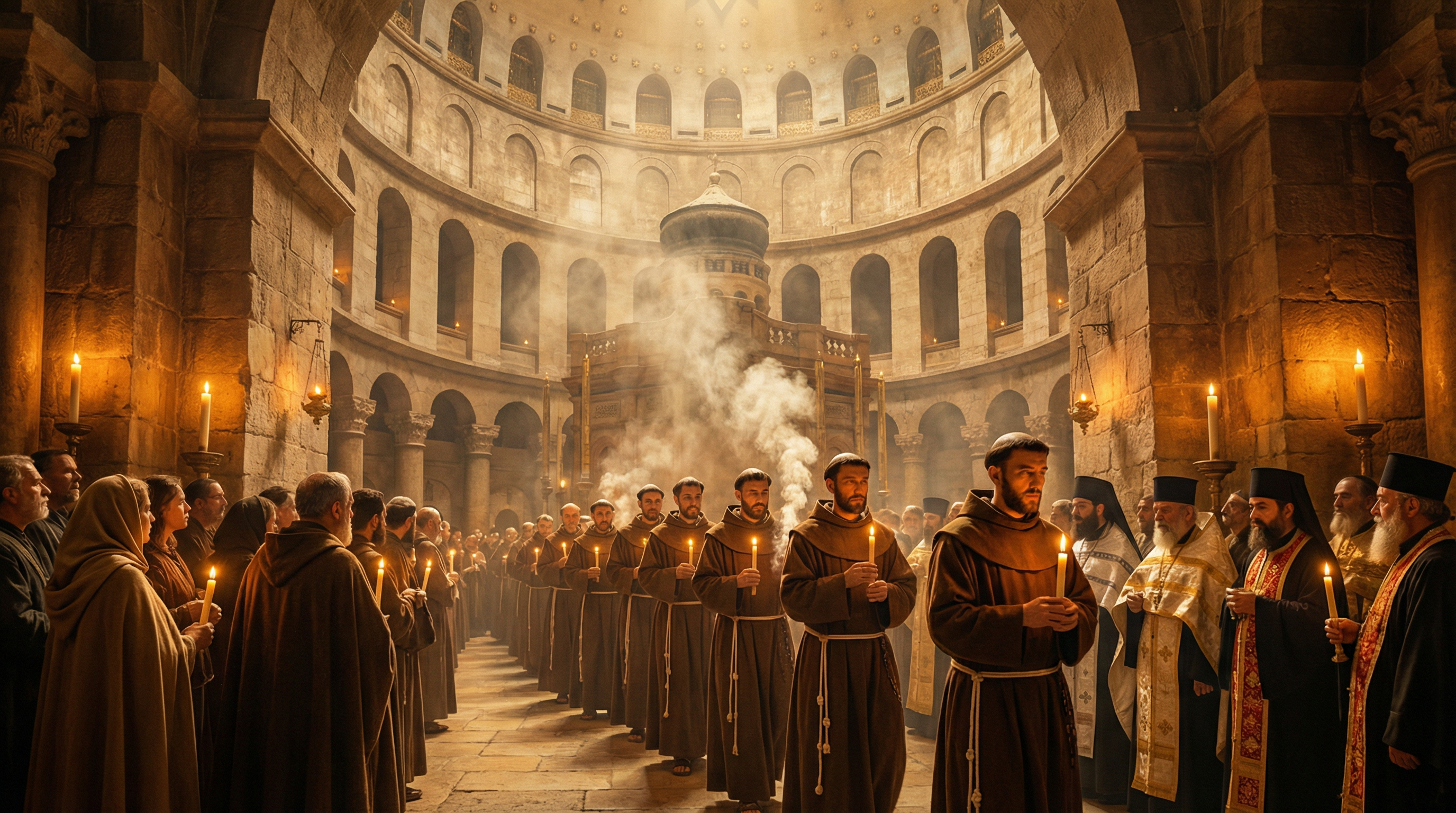
The evening procession at the Church of the Holy Sepulchre — 700 years of unbroken practice, every afternoon at 4 p.m.
The Custody of the Holy Land currently cares for 74 shrines and sanctuaries throughout Israel, Palestine, Jordan, Syria, and Cyprus. These are not museums. They are living places of worship — where daily Mass is celebrated, where pilgrims from every continent kneel and weep and pray, where the geography of the Gospels becomes tangible stone and silver and incense smoke.
The three principal shrines — the Church of the Holy Sepulchre in Jerusalem, the Basilica of the Nativity in Bethlehem, and the Basilica of the Annunciation in Nazareth — are co-administered under the Status Quo of 1852, an Ottoman-era decree that froze the rights of different Christian communities in place. The Franciscans share the Holy Sepulchre and Nativity with the Greek Orthodox and Armenian Apostolic patriarchates. In 2026, restoration of the Grotto of the Nativity began for the first time in 600 years — a joint undertaking between all three communities, overseen by Italian restorers.
"This project embodies a unified Christian commitment to preserve the spiritual, historical, and cultural patrimony of the Holy Grotto for future generations." — Joint communiqué, Greek Orthodox Patriarchate & Custody of the Holy Land, January 2026
Where the Friars Stand Watch
A selection of the 74 sanctuaries — each a chapter in the life of Christ and his prophets.
The holiest site in Christianity — the location of the crucifixion, burial, and resurrection of Jesus. The Franciscans have maintained rights here since 1342, celebrating daily Mass in the Chapel of the Apparition.
Built over the Grotto where Jesus was born. The Franciscans have guarded this site since 1347. The oldest school in the Middle East — founded by the friars in 1598 — stands nearby. In 2026, the Grotto undergoes its first restoration in six centuries.
The site where Gabriel appeared to Mary. The present basilica — the largest church in the Middle East — was built by the Franciscans between 1955 and 1969. The friars acquired the site from the Ottoman Druze prince Fakhr-al-Din in 1620.
Where Jesus prayed the night before his arrest. Ancient olive trees still root the ground. The Franciscans acquired portions of Gethsemane in 1661 and 1681. The Basilica of the Agony was built between 1919 and 1924.
The mountain where Peter, James, and John witnessed Jesus transfigured in light. The Franciscans acquired Mount Tabor before 1631. The present basilica was constructed from 1921 to 1924, incorporating Crusader-era foundations.
The site on the Jordan River where John baptized Jesus. The Franciscans maintain it as a pilgrimage site. Pilgrims wade into the Jordan's waters here every year in reenactment of the baptism.
The Archive That No One Invaded
In the archives of the Franciscan Custody at St. Saviour's Convent in Jerusalem lie thousands of documents: papal bulls, Ottoman firmans, royal correspondence, diplomatic letters, and illuminated manuscripts stretching back centuries. Unlike the great libraries of Constantinople or Alexandria, these archives have never been sacked. They have survived Crusades, Ottoman conquests, two World Wars, and the creation of modern states. They represent a uniquely unbroken record of Christian life in the Middle East.
The Terra Sancta Museum, opened in 2017 at the Church of the Flagellation on the Via Dolorosa, is the public expression of this heritage. Its second section, inaugurated in May 2025, presents the historical mission of the Custody alongside the "Treasure of the Holy Sepulchre" — liturgical objects, royal gifts, and artifacts including a remarkable collection of thirteen medieval church bells discovered under the cloister in Bethlehem in 1863. These bells had been hidden during a period of persecution and never reclaimed. They survived.
The museum's archaeological section houses finds from Franciscan excavations spanning a century of scientific work — including the Studium Biblicum Franciscanum, founded in 1924, and the first archaeological dig at Mount Nebo in 1933. These collections trace the earliest centuries of Christian presence in the Holy Land from physical evidence: pottery, inscriptions, mosaics, and artifacts that give body to the Gospel narrative.
"Our leading idea is to present our collections as the archaeological museum of Christian origins." — Terra Sancta Museum
In 2024, the Terra Sancta Museum launched a Heritage Education Hub for Palestinian youth in East Jerusalem, bringing local students into direct contact with the Christian history of their own city — regardless of their faith. It is the kind of project that makes the Franciscan Custody something more than a religious institution: it is a keeper of memory for an entire civilization.
Chapter IV: Guardians of Living Stones
The People · Schools, Parishes, Refugees
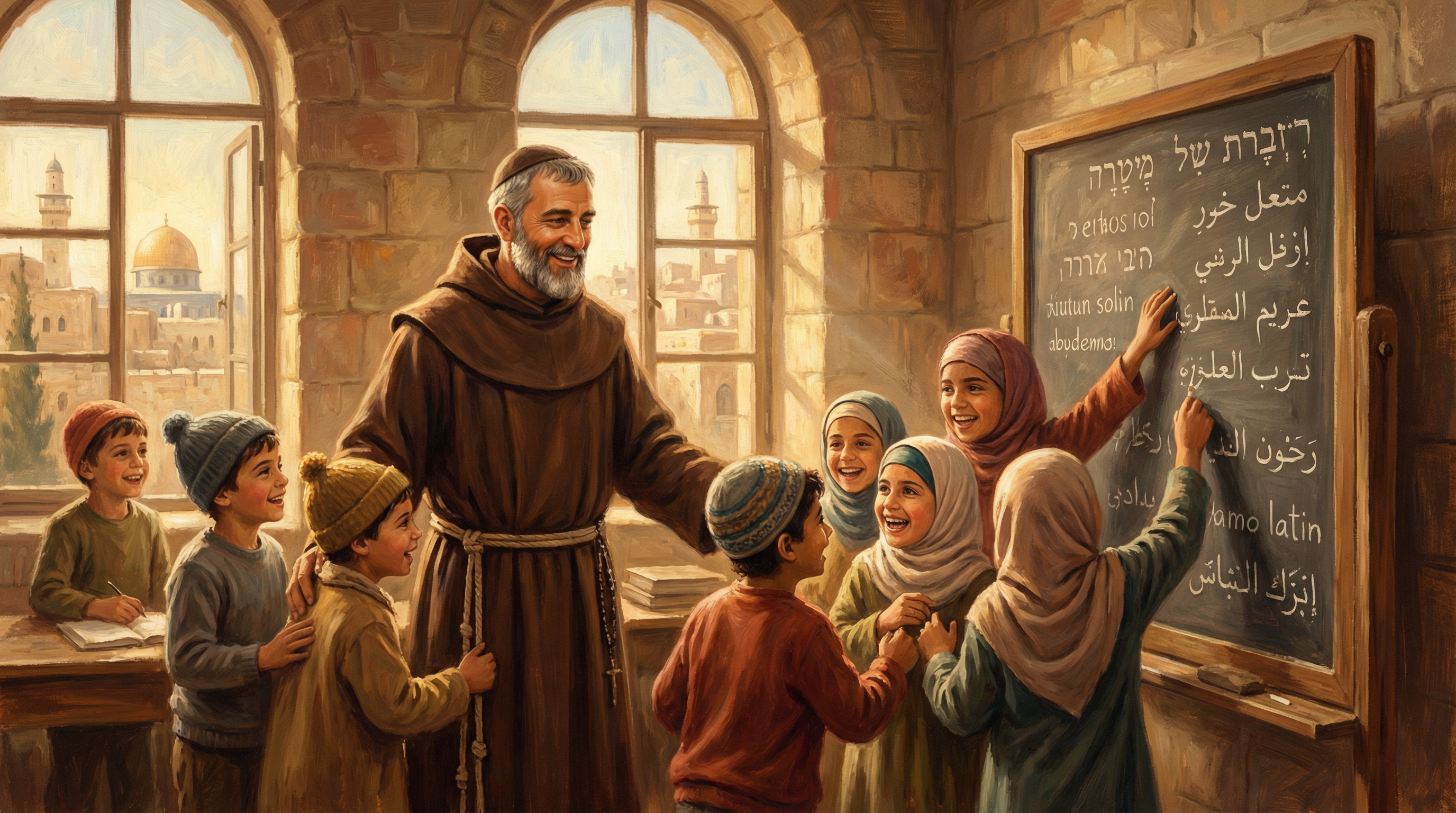
A Terra Sancta classroom — Christian, Muslim, and Jewish students together. In Jericho, 90% of students in the Franciscan school are Muslim.
There is a phrase the Franciscans use in the Holy Land: "living stones." It is drawn from the First Letter of Peter — "you yourselves, like living stones, are being built up into a spiritual house." In the context of the Custody, it refers to the local Christians themselves. The shrines can be preserved in stone indefinitely; but if the people who worship in them leave, the holy places become museums. The heart of the Franciscan mission is keeping people here.
The numbers tell the story of a community in crisis. In 1922, Christians made up 11% of Palestine's population — approximately 70,000 people. By 2017, the Palestinian Authority census counted 47,000 Christians, roughly 1% of the population. The trajectory is unmistakable. Franciscan schools, built across the region for over four centuries, are the single most powerful tool against this exodus. Br. Ibrahim Faltas, Director of Terra Sancta Schools, states it plainly: "The education that we Franciscans provide to the local community is the main incentive for Christians to remain in the Holy Land."
What the Custody Does Every Day
The Custody operates 16–18 schools across Israel, Palestine, Jordan, and Cyprus. More than 10,000 students attend — Christian, Muslim, and Jewish alike. In Jericho, 90% of students in the Franciscan school are Muslim. The oldest school in the Middle East, founded in Bethlehem in 1598, is a Franciscan institution.
10,000+The Custody supports 29 Catholic parishes across the region, keeping sacramental life alive in communities that have dwindled to handfuls of families. Four homes for orphans and three academic institutions are also maintained. The first Catholic parish in Jerusalem — St. Saviour's, founded in 1560 — is still active.
29 ParishesThe Custody provides hundreds of apartments at nominal rent to Christian families in Jerusalem, Bethlehem, and surrounding areas. Major housing projects include St. James Housing (42 apartments), St. Francis Village (90 apartments), and multiple Bethlehem complexes. The goal is simple: give families a reason to stay.
350+ ApartmentsThe Custody assists Syrian and Iraqi refugee families in Jordan and Lebanon — paying rent, food, heat, schooling, and transportation. In Gaza, the Custody supports the Latin Parish and partners with Caritas on food distribution, medical care, and cash assistance to displaced families. Emergency funds flow to families in acute crisis throughout the region.
OngoingThe Magnificat Music Institute, affiliated with the Conservatory of Vicenza, offers music education to Christian, Muslim, and Jewish students in Jerusalem — taught by professors of all three faiths. The Franciscan Printing Press, founded in 1848, publishes books and research. The Christian Media Center broadcasts liturgies and documentaries worldwide.
3 InstitutionsThe Studium Biblicum Franciscanum (founded 1924) is one of the leading schools of biblical science and archaeology in the world. Students come from every continent. The Custody provides room, board, and scholarships for students from poor religious provinces. Over a century, the friars have conducted excavations at Mount Nebo, Capernaum, and sites across the Holy Land.
Since 1924Chapter V: A Day in the Life of a Friar
Field Reports · Daily Witness
The daily procession at the Holy Sepulchre — 700 years of unbroken practice. The lead friar carries the thurible; pilgrims follow with beeswax candles. Behind them, the Edicule — the tomb of Christ — glows in the candlelight.
It begins in the dark. At 4:00 a.m., a bell rings in the convent of St. Saviour in Jerusalem's Christian Quarter. The friars rise for Lauds — the ancient morning prayer of the Church — before the Old City has stirred. Then, depending on their assigned role, the day branches in entirely different directions. Some process to the Holy Sepulchre to open its ancient wooden doors. Some travel by bus or on foot to the West Bank to visit a village parish. Some prepare for a school day with a classroom of 40 children in Jericho or Nazareth. Some sit at a desk and draft a report for the Italian Ministry of Foreign Affairs about a housing permit held up for two years in Jerusalem's municipal bureaucracy. All of them are, in the language of their founder, minores — lesser brothers — servants before they are anything else.
"Our centuries-old presence in the Holy Places of the Redemption and the prayer that rises there every day are offered in the name of the whole Church and for the good of all humanity." — Franciscan Community at the Holy Sepulchre, March 2026
The most visible expression of the friar's daily life is the Ordo Processionalis — the daily procession at the Basilica of the Holy Sepulchre. Every afternoon at 4:00 p.m., a column of Franciscans in brown habits, one carrying a swinging thurible of incense, moves in chanted procession through the 14 stations of the basilica's interior. They have done this, without interruption, for more than 700 years. Gregorian chant echoes under the great Rotunda dome — Stabat Mater, Adoro Te Devote, antiphons composed in the 13th century by a Franciscan friar from Todi. International pilgrims follow behind, holding lit beeswax candles given to them at the entrance. Some weep. The procession is a sacramental: the Church's ancient practice of walking the Gospel rather than merely reciting it.
But the friar's day extends far beyond the Rotunda. The Status Quo of 1852 — the Ottoman decree that governs shared use of the Holy Sepulchre, the Nativity, the Tomb of the Virgin, and the Ascension Shrine — means that every liturgy, every candle placement, every cleaning schedule is a matter of inter-community negotiation. Brother Athanasius Macora, the Custody's Status Quo manager, puts it plainly: "Everything is the result of an agreement between the communities. Traditionally, variations cannot be made, because any change could create problems for the other church. So no one can change the time of the procession without agreeing it with the others." The friar as diplomat. The friar as negotiator. The friar as the patient interpreter of 800 years of accumulated tradition.
Beyond the Holy Sepulchre, a friar assigned to one of the 29 parishes might spend a morning in a village in Galilee, celebrating Mass for a community of 60 people — mostly elderly, the young having emigrated to Haifa or Amman or Detroit. He hears confession in Arabic. He blesses a newborn. He helps a family appeal a permit denial that has prevented them from building a needed room onto their home. He drives back through a checkpoint, showing his brown habit — which, since the Ottoman period, has served as its own kind of diplomatic passport — to the soldiers at the barrier.
A friar at a Terra Sancta School in Jerusalem or Bethlehem might begin the school day with 40 students: Christian Palestinians, Muslim Palestinians, occasionally Jewish Israeli children whose families chose the school for its reputation. He teaches mathematics, or Arabic literature, or scripture. At lunch he eats with the students. After school he meets with a family whose scholarship application is under review — a university place in Italy or the United States that might be the difference between a son staying or leaving. These are the calculations the Custody makes every day: not whether a shrine is clean, but whether a family can afford to stay.
A friar at the Studium Biblicum Franciscanum might spend his day in an archaeological archive, annotating pottery shards from a first-century site near Capernaum. A friar at the Christian Media Center edits footage for a live broadcast of the Easter Vigil from the Holy Sepulchre — sent to hundreds of millions of households worldwide. A friar in the Terra Sancta Museum prepares a new display case for one of the 13 medieval bells found beneath the Bethlehem cloister in 1863. A friar at the printing press corrects proofs of a new scholarly monograph on Syriac manuscripts.
At evening prayer — Vespers, and then Compline — the community reassembles in the chapel of St. Saviour's. The day has been twelve hours long and has spanned four languages, three sovereign jurisdictions, and two millennia of history. The office closes with the Salve Regina — "Hail, Holy Queen, Mother of Mercy" — a hymn the Franciscans have sung here since 1342. The same chant, the same chapel, the same intention: that God's holy ground remain inhabited by his people.
Chapter VI: Custody in a Time of Walls and Wars
Checkpoints, Conflict, and the Mission of Peace · 1948–Present
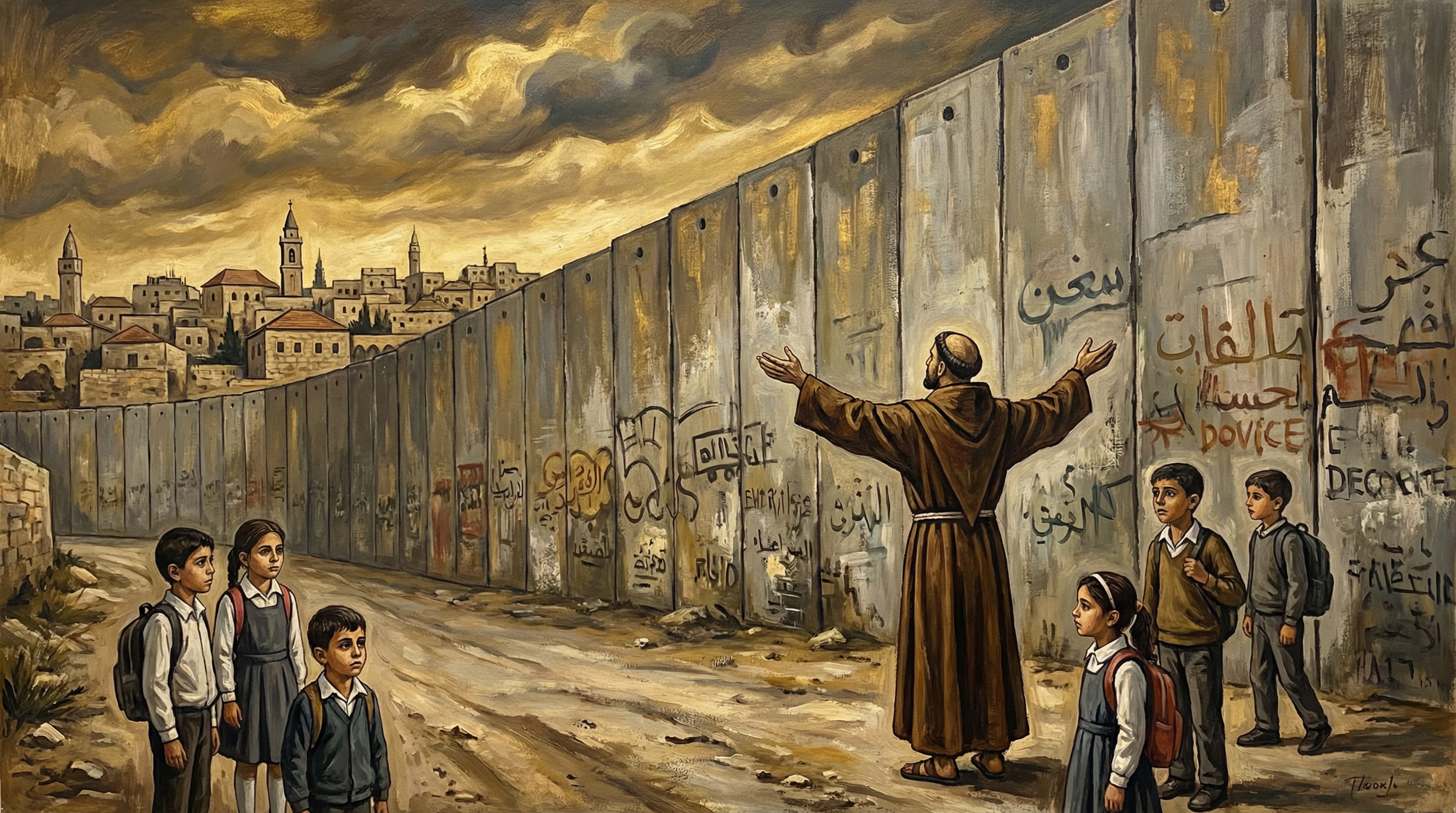
Near Bethlehem, the separation wall cuts across land that has been farmed and prayed over for 3,000 years. A friar with the local Christian community — the smallest minority on all sides of the conflict.
In April 2026, Cardinal Pierbattista Pizzaballa — himself a former Custos of the Holy Land, made a cardinal by Pope Francis in 2023 — was blocked by Israeli police from entering the Church of the Holy Sepulchre on Palm Sunday. It was, as his office noted, "the first time in centuries" that the Latin Patriarch had been refused entry to the holiest site in Christendom on the day commemorating Christ's return to Jerusalem. The reason given was security: ongoing Israeli-Iranian hostilities had placed Jerusalem under restrictions on public gatherings. After a day of international pressure, Prime Minister Netanyahu personally ordered that Pizzaballa be granted "full and immediate access." The episode lasted less than 24 hours. But it crystallized, in a single scene, the existential conditions under which the Custody has operated for the past 80 years.
"We will not resign ourselves to imagining a Middle East without Christians. We call on the international community to pay attention to this reality." — Pope Francis
The Israeli-Palestinian separation barrier — over 700 kilometers of concrete wall and wire fence — has reshaped Christian community life in ways that statistics cannot fully capture. In the Cremisan Valley outside Bethlehem, the Custody joined a decade-long legal battle against a planned wall route that would have bisected a Salesian convent and monastery, cutting nuns from the school and community they served. In 2015, Israel's Supreme Court blocked the plan — a rare legal victory that church officials called "an early Easter gift." But in dozens of other places, the wall went up without legal recourse, separating farmers from their olive groves, families from their parishes, and Christian communities in Jerusalem from those in Bethlehem.
The effects are measurable in emigration statistics. Every checkpoint that makes a commute into an hour-long ordeal is a reason to leave. Every work permit denied is a reason to accept the job offer in Amman or Sydney. Every young Christian man who cannot access his university in Jerusalem without hours of waiting at a gate is one generation closer to a Holy Land in which the "living stones" are only archaeological. The Franciscan Foundation for the Holy Land estimates that without sustained intervention — housing, scholarships, jobs, community anchoring — the indigenous Christian population could effectively cease to exist as a community within 50 years.
Gaza: The Smallest Parish in the World
In Gaza, there is one Catholic parish: the Holy Family Parish in Gaza City. Before October 7, 2023, it served approximately 135 registered parishioners — a community that had survived the Ottoman period, the British Mandate, the 1948 war, the 1967 occupation, and decades of blockade. After the outbreak of the current war, over 600 additional people — Christian, Muslim, and of no faith — took refuge in the parish compound, which became a de facto shelter amid the bombardments.
Pope Francis has called the parish priest in Gaza every day since the war began. The Pontifical Collection for the Holy Land — the Good Friday collection taken up by Catholic parishes worldwide, 65% of which goes directly to the Franciscan Custody — was redirected in 2024 to humanitarian efforts in Gaza, funding food distribution, medical supplies, cash assistance to displaced families, and the extraordinary "Butterfly Program," providing care for 33 children in Gaza suffering from epidermolysis bullosa, a severe inherited skin disease.
The most dramatic expression of the Custody's response to the Gaza crisis was the work of Fr. Ibrahim Faltas, Vicar of the Custody and Director of the Terra Sancta Schools. A native Egyptian with deep knowledge of Middle Eastern diplomacy, Faltas coordinated with the Italian government and the Palestinian Ambassador to Italy to evacuate severely injured and ill children from Gaza through the Rafah crossing into Egypt and then by military airlift to Rome's Ciampino airport. The first 11 minors arrived on January 29, 2024, greeted by Faltas, the Italian Foreign Minister, and the General of the Italian military. "Faced by the tragedy of these children, innocent victims of the conflict," Faltas said, "I immediately took action with the hospitals and with the Italian government, and straightaway received truly commendable agreement and participation from everyone."
This is the friar as diplomat, as humanitarian coordinator, as the Church's operational arm in the most dangerous geography in the world. It is not what most people imagine when they picture a brown-robed figure kneeling in prayer at the Holy Sepulchre. But it is precisely the same vocation: being where Christ would be, with the people Christ would serve.
Chapter VII: The Blood of the Martyrs
Key Figures · Martyrs and Custodians
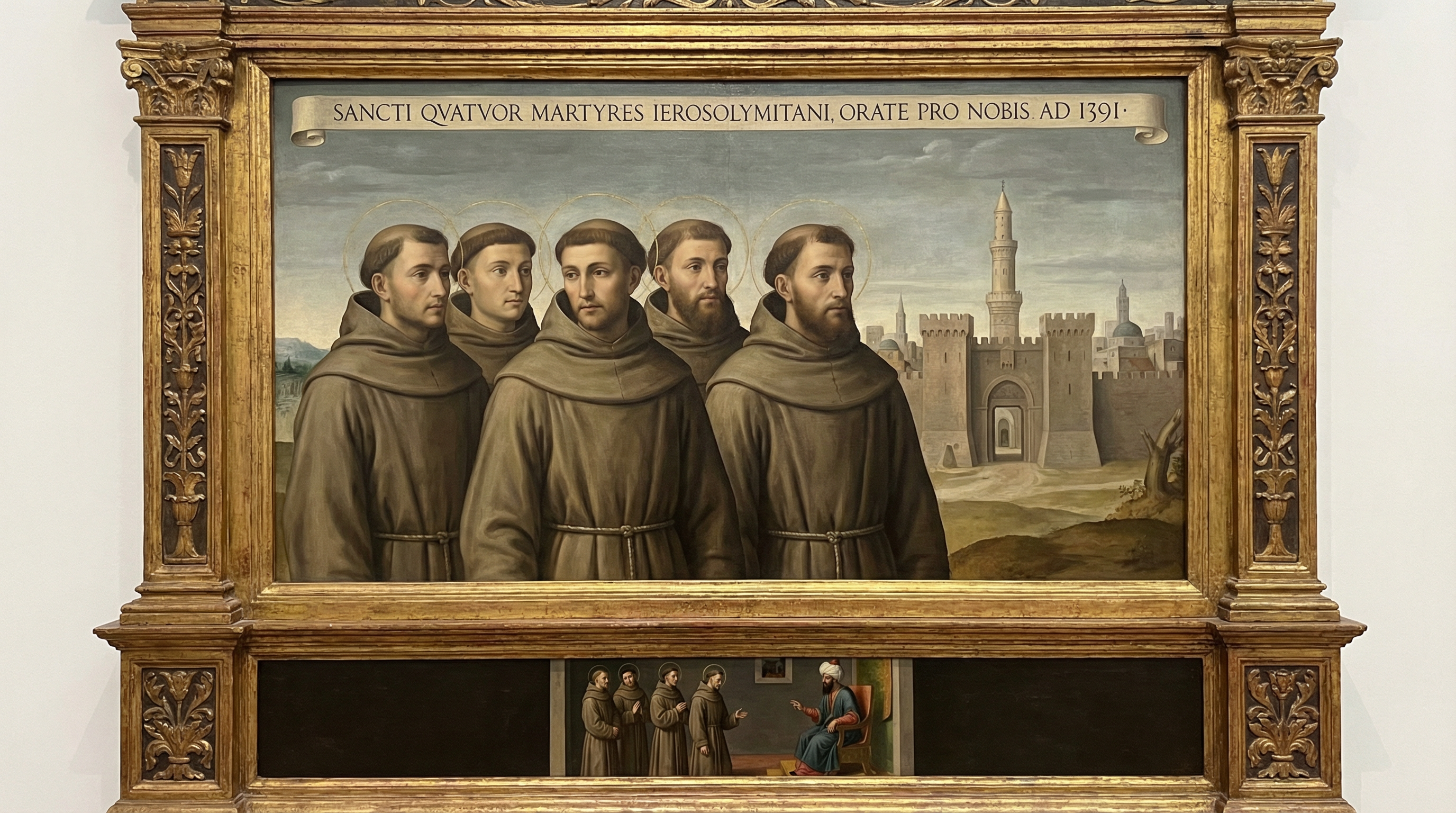
St. Nicholas Tavelic and his three companions — beheaded in Jerusalem on November 14, 1391, after voluntarily appearing before the Mamluk religious court to preach the Gospel. Canonized by Pope Paul VI in 1970.
The Custody of the Holy Land has produced hundreds of martyrs — friars killed for their faith across eight centuries of tumultuous presence. Only four have been canonized as saints: Nicholas Tavelic and his three companions, Deodatus of Ruticinios, Peter of Narbonne, and Stephen of Cuneo. Their feast is celebrated on November 14. They were beheaded in Jerusalem on November 14, 1391, by order of the Mamluk Qadi, after they had gone voluntarily to the Muslim religious court and preached the Gospel. They knew the sentence would be death. They went anyway. Nicholas Tavelic, born in Croatia around 1340, had spent years as a missionary in Bosnia before arriving in the Holy Land. His final act was not passive martyrdom but deliberate witness: an act of evangelical audacity that Francis himself would have recognized.
"They are the only Franciscans martyred in the Holy Land to be canonized — but they are not the only ones who gave their lives." — Franciscan tradition
Born into Croatian nobility c. 1340, Nicholas spent years as a Franciscan missionary in Bosnia before arriving in the Holy Land. He and three companions voluntarily appeared before the Mamluk religious court to preach the Gospel. They were beheaded on November 14, 1391. Canonized by Pope Paul VI in 1970.
Served as Custos of the Holy Land for twelve years before being appointed Apostolic Administrator, then Latin Patriarch of Jerusalem. Made a Cardinal by Pope Francis in 2023. In October 2023, he publicly offered himself as a hostage in exchange for Israeli children held by Hamas — an offer that drew international attention and embodied the Franciscan tradition of placing body before institution.
Native Egyptian and Vicar of the Custody of the Holy Land. Director of the Terra Sancta Schools, overseeing 12,000 students across the region. In 2024, he personally coordinated the evacuation of injured Gazan children to hospitals in Italy, working directly with the Italian government and military. A central voice for children and peace throughout the war.
Served as Father Custos from 2016, reconfirmed in 2022. Under his tenure, the Terra Sancta Museum opened its second section and the Grotto of the Nativity restoration project was launched. Succeeded in 2025 by Fr. Francesco Ielpo, who was with Cardinal Pizzaballa during the Palm Sunday blockade incident at the Holy Sepulchre in March 2026.
One of the greatest biblical archaeologists of the 20th century. A Franciscan friar who spent his career excavating sites across the Holy Land — Nazareth, Capernaum, Mount Nebo, the Tomb of the Virgin. His finds are foundational to the modern understanding of early Christian presence in the region. The Studium Biblicum Franciscanum carries forward his legacy.
One of the great scholar-Custodes. First lecturer in Arabic at the College of San Pietro in Montorio in Rome — the Franciscan institute that trained missionaries for the Holy Land. In 1623 he codified the definitive revision of the Holy Sepulchre daily procession — the Ordo Processionalis — which remained in essentially the same form for 300 years.
Chapter VIII: The Meaning of Custody
Theology of Presence · Poverty · Peace
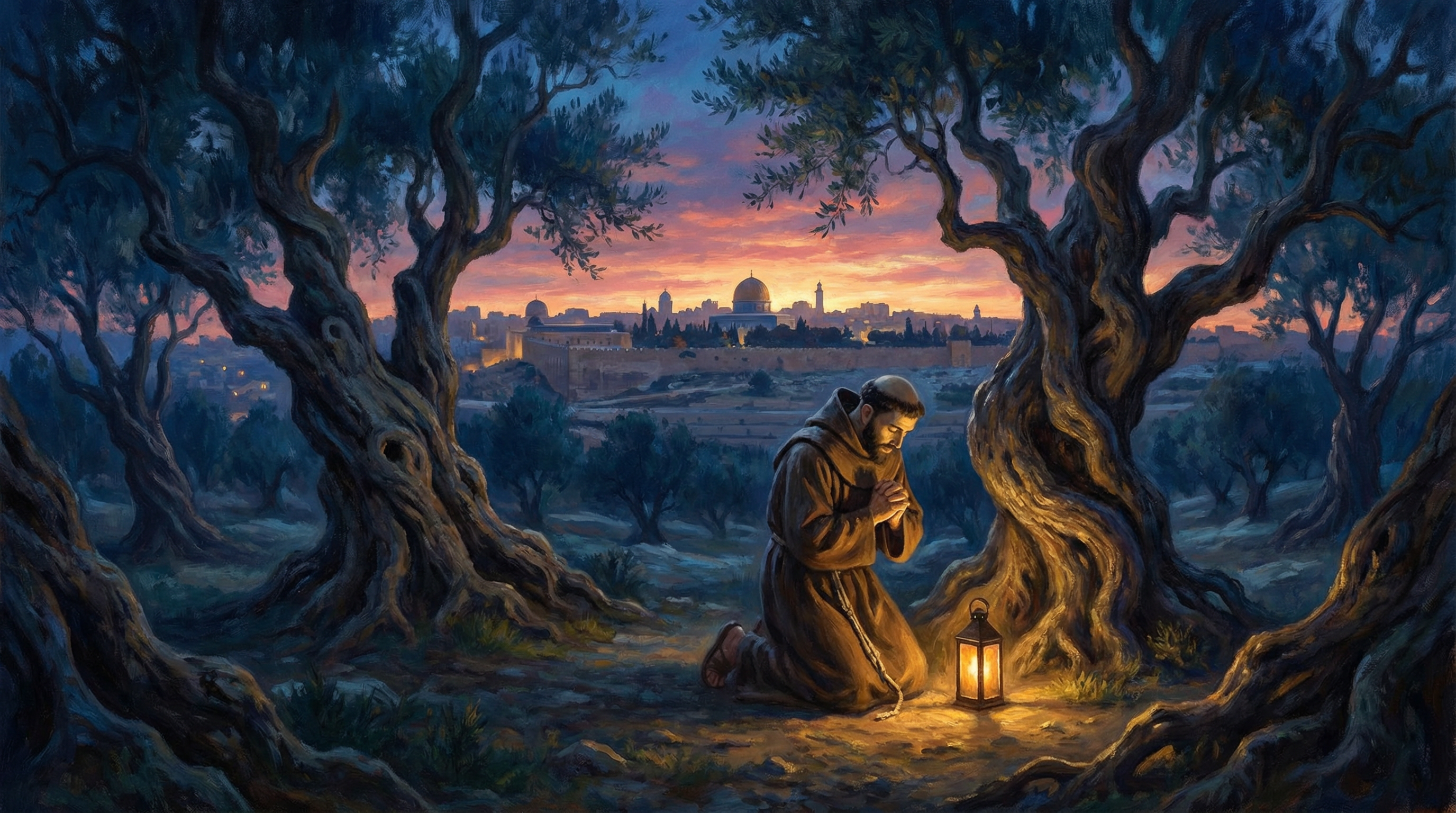
The Garden of Gethsemane at dawn — the same olive trees, the same stones, the same silence. The Franciscans have kept vigil here since 1681.
The word "custody" is not, in the Franciscan tradition, a word of power. It carries no sovereignty, no dominion, no claim of ownership. The Latin root — custodia, from custos, "guard" or "keeper" — implies a temporary stewardship over something that belongs to someone else. You are placed in charge of what you do not own, on behalf of those who cannot be present. This is the theology of the Custody in a single word.
Francis of Assisi grasped this instinctively. He named his movement not after himself, not after a doctrine, but after the quality of smallness: Fratres Minores, the "Lesser Brothers." The word minor in 13th-century Italian society had a precise social content: it referred to those without power — the poor, the landless, the excluded. Francis chose to put himself and his friars deliberately among them. The formal theological term for this is minoritas — a voluntary renunciation of power, a conscious placement of oneself at the bottom of every hierarchy. It is, he believed, the only position from which one can truly serve.
"For there is no Incarnation without a place. For us, loving this land means to love Jesus. And we cannot think of Jesus without loving His land." — Custodia di Terra Santa
This is why the Franciscan presence in the Holy Land is, at its root, a theological argument made in the form of a life. The argument is this: the places where God became flesh — where he was born, walked, prayed, suffered, and rose — are not merely historical sites. They are the material expression of the Incarnation. To care for them is not heritage preservation; it is a form of love directed at Christ himself. "The Holy Places, however much their beauty can be admired, are not just stones," the Custodia states. "They are the manifestation, the footprints of the passage of God in this world." Listening to the voice that springs from those stones is, in the Franciscan understanding, inseparable from following Jesus.
The same logic extends to the people. The "living stones" — the phrase drawn from 1 Peter 2 — are the local Christians themselves. They are not metaphors; they are the continuation of the Pentecost community in an unbroken human chain. Every Christian family that leaves Bethlehem or Nazareth permanently is a link broken in that chain. The Franciscan Custody's schools, housing programs, scholarships, parishes, and emergency funds are not charity work supplementary to the "real" mission of guarding shrines. They are the same mission, in a different register. You cannot preserve the place where the Gospel was lived while allowing the people descended from its first hearers to disappear.
"The Holy Places are stones which heard the words and drank the blood of our Saviour. That word of God and that blood now have to be collected and preserved because they are part of the life of every Christian." — Custodia di Terra Santa
There is a final dimension to this theology that the Franciscans inherited directly from Francis: the conviction that peace is not a political outcome but a way of being present. Francis went to the Sultan not because he thought he could end the Crusades but because he believed the Gospel required him to be there, in that tent, with that man, speaking truth without a sword. Eight hundred years later, a friar negotiates with an Israeli policeman to allow access to the Holy Sepulchre on Palm Sunday. A friar coordinates with the Egyptian government to evacuate children from a bombed city. A friar teaches a classroom of Muslim and Christian students in Jericho and calls it a form of prayer. They are different acts in different centuries — but the posture is identical: unhurried, unarmed, present.
This is the answer to the question of why the Franciscans are still in the Holy Land after 800 years, when empires rose and fell and entire populations were displaced around them. Not because they were protected by power. Not because they won any wars. But because the Franciscan understanding of holiness is inseparable from a specific place, a specific people, and a specific kind of stubbornly humble presence that no empire has ever quite known how to remove.
Timeline: Eight Centuries at a Glance (1217–2026)
Epilogue: The Oldest Continuous Christian Presence
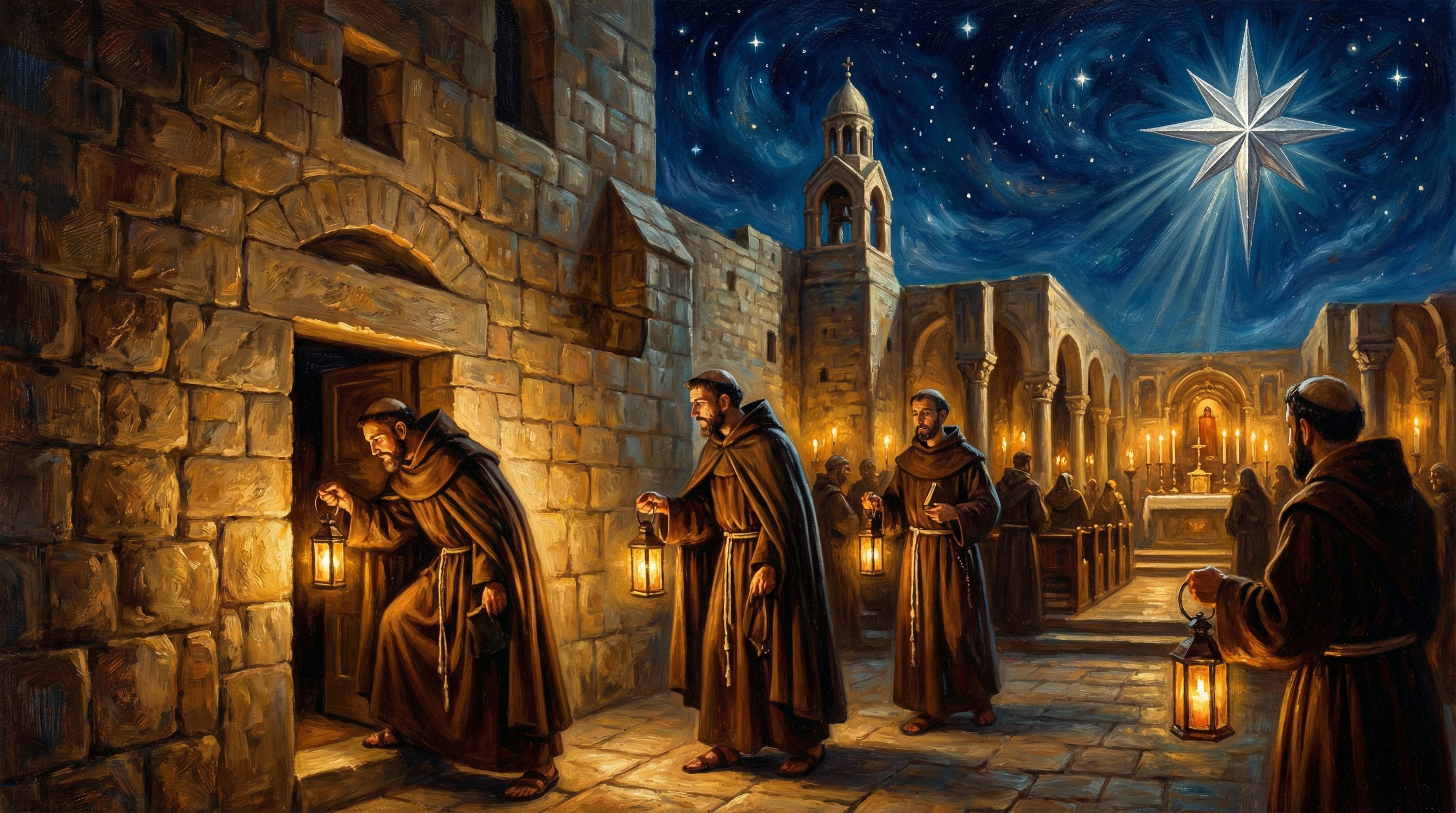
Bethlehem at midnight Mass, Christmas Eve — the Grotto of the Nativity in candlelight, Franciscan friars processing to the site where, by tradition, God became flesh.
Eight hundred years after Brother Elias landed in Acre, the Franciscans are still there. They walk the same stones, celebrate Mass in the same candlelit sanctuaries, and teach in the same classrooms that their predecessors built when the Ottoman Empire was young. They have no armies, no political leverage, and no claim to sovereignty. What they have is the most durable force in human history: faithful, habitual presence.
In a region where Christians are leaving — driven by economic hardship, political instability, and the weight of being a minority in a place that has never been easy — the friars stay. They stay because Francis stayed. Because the Gospel commands it. Because someone must be there to open the doors of the Church of the Holy Sepulchre at 4 a.m. on Easter morning, and light the first candle in the dark.
"We will not resign ourselves to imagining a Middle East without Christians." — Pope Francis
The Franciscan Custody is not a relic. It is not a heritage organization or a museum guardianship. It is a living community of men who have chosen to place their bodies in the most contested geography in the world and say, by that choice: this place matters, these people matter, and we are not leaving. They have outlasted the Mamluk Sultanate, the Ottoman Empire, the British Mandate, and every political settlement that has come since. The walls go up; the friars stay. The wars begin; the friars stay. The pilgrim numbers collapse; the friars stay, celebrating Mass in an empty basilica as an act of faith that someone will eventually return.
There is a word for this in the Christian tradition: perseverantia — perseverance. Not the dramatic perseverance of the martyr who dies in a single moment of witness, but the quiet, grinding perseverance of showing up every day, for 800 years, with a breviary and a rope belt, to pray the same prayers in the same places where Christ once walked. It is the most demanding vocation in Christianity, and the least celebrated. It is also, in the end, the one that kept the holy places open.
Constantine's Codex documents legacies that have bent the arc of history — systems, movements, and institutions that shaped human civilization not through force but through the slow accumulation of faithful action over time. The Franciscan Custody of the Holy Land belongs among the greatest of them.
Sources & Further Reading
- Custodia di Terra Santa — Official History
- Franciscan Monastery of the Holy Land in America
- Terra Sancta Museum, Jerusalem
- Franciscan Foundation for the Holy Land
- Wikipedia — Custody of the Holy Land
- Holy Land Franciscan Pilgrimages
- Focolare Media — The Franciscans and the Custody
- Vatican — Good Friday Collection Report, 2026
- Aleteia — Franciscan Schools and the Christian Presence
- Catholic Register — Grotto of the Nativity Restoration